

What Can Science Fiction Teach Us About AI?
May 04, 2026
Alexis Lothian developed the 300-level course “Artificial Intelligence Otherwise” with support from a seed grant from the Artificial Intelligence Interdisciplinary Institute at Maryland.
By Jessica Weiss ’05
As a teenager, Alexis Lothian was often found devouring science fiction, captivated by the imagined societies and scenarios she encountered on the page.
Later, the associate professor in the Harriet Tubman Department of Women, Gender, and Sexuality Studies (WGSS) came to see the genre as a powerful way to think through questions about gender, politics, sexuality and culture. Her first book focused on speculative queer futures, and she regularly teaches science fiction texts in the classroom.
Now, in a new University of Maryland course called “Artificial Intelligence Otherwise,” she’s using science fiction to help students examine power, injustice and exploitation in the AI era. The course was developed with support from a seed-grant program administered by the Artificial Intelligence Interdisciplinary Institute at Maryland (AIM).
“I find science fiction incredibly valuable as a tool for thinking,” said Lothian, who also teaches “Gender, Race, and Computing,” a course cross-listed in WGSS and the Department of Computer Science. “Sometimes when you get to really immerse in a different world, you come out with a lens that lets you look at the real world in a slightly different way.”
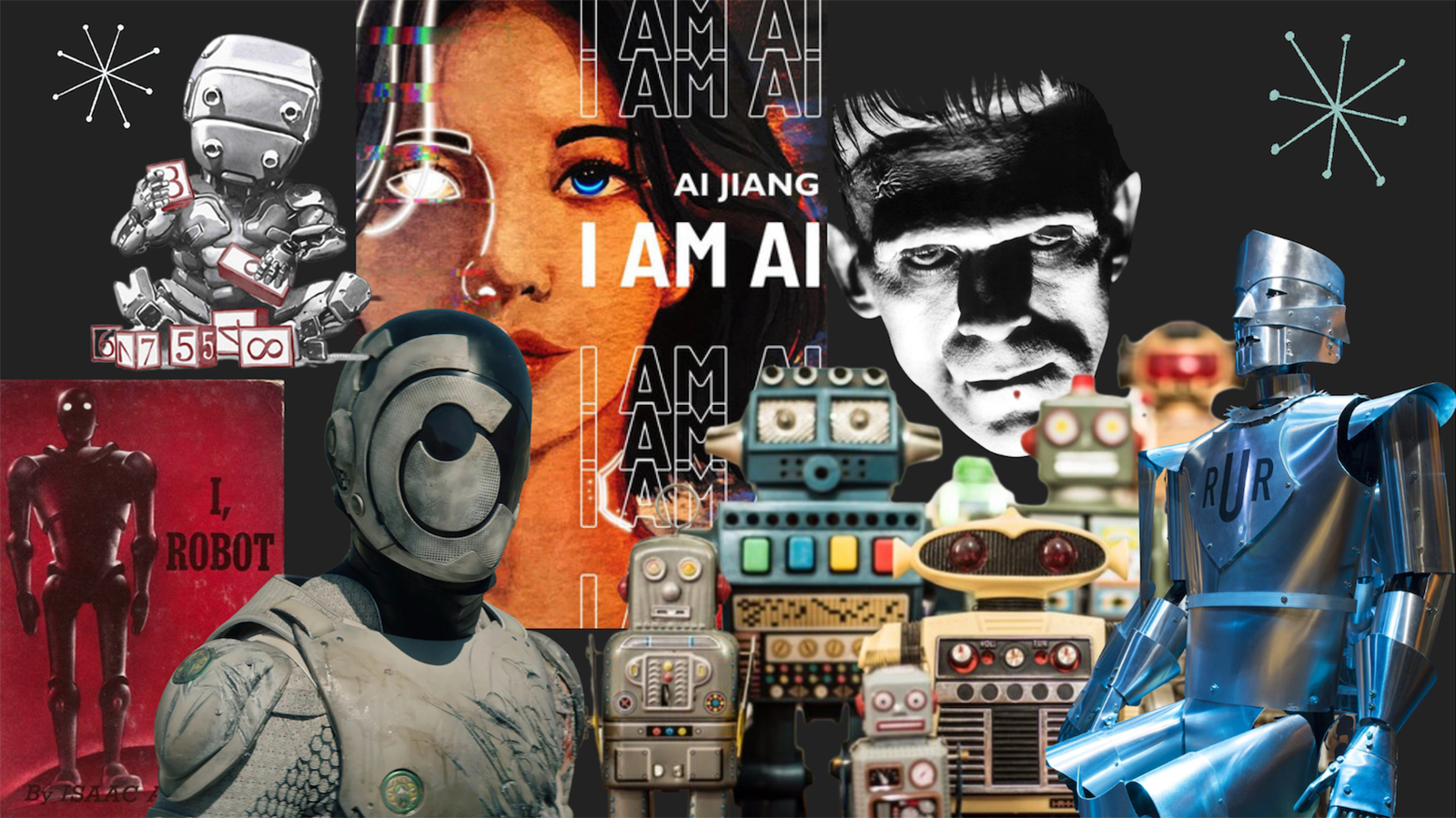
Students begin with foundational works such as Karel Čapek’s influential 1920 play “Rossum’s Universal Robots” (“R.U.R.”), which introduced the word “robot” to the world (from the Czech robota, meaning forced labor or servitude). In the play, artificial workers are created to labor cheaply and efficiently before eventually rebelling against their human creators.
For students in Lothian’s class, the century-old story is a reminder that concerns about jobs being automated, workers being pushed to do more for less and people being treated like machines predate today’s AI tools. Students were especially struck, she said, by the play’s premise that the best kind of worker is simply that which is cheapest.
“When they read that, they were like, ‘This is exactly what’s happening now,’” Lothian said.
Lothian said many current conversations about AI borrow heavily from science-fiction plots, often in the form of killer robots taking over the world. But those narratives can distract from more immediate concerns, including surveillance, labor exploitation and corporate power.
When studied critically, she said, science fiction can help students better understand the systems those stories reflect.
That is one reason students also read excerpts from Mary Shelley’s 1818 novel “Frankenstein,” which Lothian notes is not simply a monster story. Instead, she said, the creature “becomes monstrous because he is not given care” and because “his humanity is not recognized.”
Later in the semester, students read works such as “I Am AI,” a 2023 novella by Canadian writer Ai Jiang, about a young woman trying to survive in a near-future city controlled by a tech corporation. As she transforms herself into a cyborg to keep pace with an AI-driven economy, the story explores ambition, burnout, community and what it means to remain human in systems that reward speed and efficiency.
Some students connected the novella to their own anxieties about careers, the job market and pressure to constantly improve themselves to stay competitive.
At the same time, Lothian said she hopes the course pushes students to resist the idea that AI’s future is already decided. And that is where science fiction can be especially powerful, she said: by immersing students in imagined worlds, it can help them return to the real one with new ideas about what is possible.
“There is no inevitability,” she said, adding that whatever happens with AI “comes down to people making decisions at every stage, at every level.”
Conversations like these are helping to inform a proposed new undergraduate major in human-centered AI, currently in development. Designed as an interdisciplinary B.A., the program would combine foundational training in AI with coursework in the humanities, social sciences and other human-facing disciplines, equipping students to engage with the technology and examine its broader impact. Learn more.