

Professor Emerita Merle Collins Recovers Overlooked Life of Louise Little
February 23, 2026
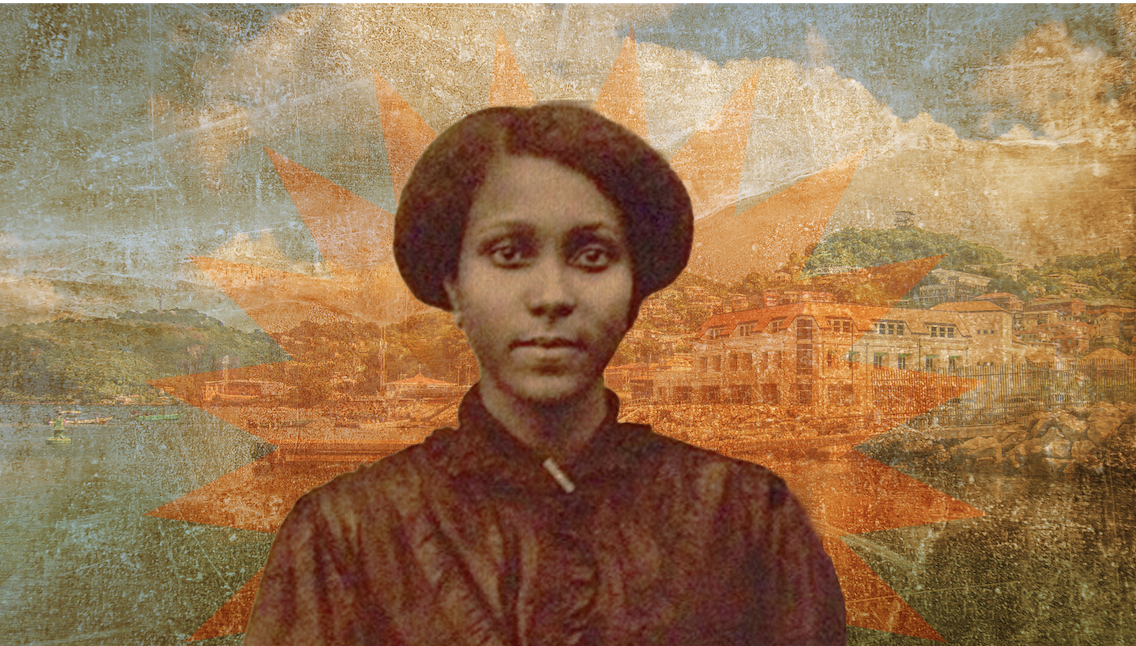
Collins received the Barbara T. Christian Literary Award for “Ocean Stirrings.”
By Chelsea McLin M.A. ’19
For decades, the story of Malcolm X has been told and retold. But the story of the woman who shaped him has remained largely in the margins.
In her novel “Ocean Stirrings,” Professor Emerita Merle Collins centers on Louise Little, a Grenadian-born activist, community organizer and the mother of Malcolm X. The award-winning 2023 novel reconstructs Little’s world across colonial Grenada, migration and racial terror in North America.
Collins, who has taught for more than two decades in the Department of English and is also from Grenada, received the 2025 Barbara T. Christian Literary Award at the Caribbean Studies Association’s 49th annual conference for the novel. It was also a finalist for the 2024 Orwell Prize for Political Fiction.
We recently interviewed Collins to reflect on recovering Black women’s voices, the power of historical fiction and the urgency of Louise Little’s story today.
“Ocean Stirrings” focuses on Louise Little rather than Malcolm X. Why was it vital to give her a voice?
I was drawn to her because she was largely invisible, even in “The Autobiography of Malcolm X.” Returning to the book a few years ago, I was struck by the lines in the opening chapter: “Louise Little, my mother, who was born in Grenada, in the British West Indies, looked like a white woman. Her father was white. She had straight black hair, and her accent did not sound like a Negro's. Of this white father of hers, I know nothing except her shame about it.”
That motivated me to go looking for this Black woman born in rural Grenada in a plantation environment. What is her story? And how did her life shape someone who would later become so central to Black identity globally?
What about “Ocean Stirrings” do you think resonated most with the award committees?
Perhaps the connection between politics and literature, made possible by my use of fictional elements, was a key factor. The book emphasizes how British colonial influence shaped Caribbean identity. I like to think that how language was used to explore all of that interested them. I wanted to return to Louise Little’s origins in Grenada and to look at migration and questions of becoming. When I say “becoming,” I'm talking about her own interrogation of self and history as she spoke to her children in the diaspora. What struck me was that Malcolm X and his siblings were both African American and African Caribbean, something that is not often highlighted in his story. I wanted to explore that without focusing on Malcolm himself, but instead on his mother.
I was interested in her experience growing up in late 19th and early 20th-century Grenada, shaped by French and British colonialism—how that influenced her language, her ideas about race, culture and colorism. I see this in “The Autobiography of Malcolm X,” particularly in how she taught her children about colorism. For example, Malcolm’s father, who was from Georgia, was dark-skinned. Malcolm X thought he was his father’s favorite because he was the lightest of the children, whereas his mother was constantly telling him not to think of light skin as something more important than dark skin.
She herself was the child of a white man and a Black woman and could have passed for white, but she chose not to. I was deeply inspired by how she lived her life and the values she passed on to her children.
“Ocean Stirrings” traces a life shaped by colonialism, migration and state violence. You also lived through similar experiences in Grenada.
My early education was very much shaped by a colonial setting. I grew up in Grenada, and my schooling was steeped in British literature—Shakespeare, Hardy, the Romantics, the Victorians. I loved the language, and I loved the theatrical elements too. I participated in productions of “Macbeth” and other plays. That was my world.
Later, studying Caribbean and Latin American literature, the colonial and the post-colonial came together. I returned to Grenada and taught there. During the revolutionary period from 1979 to 1983, I worked with the revolutionary government, which was deeply impactful for me—not just politically, but intellectually and imaginatively.
After that period, my work became increasingly interdisciplinary. I realized much of Grenada’s historical record was housed in British archives, so I spent years researching there and trying to understand how Grenada moved from colonialism to independence, to revolution, to invasion.
You’ve worked across poetry, fiction and criticism, and “Ocean Stirrings” blends many forms, including narrative, letters and poetry. How do you decide what form a story needs, and why was this right for Louise Little’s story?
Those decisions emerge as I interrogate the story itself. As I began researching, I started thinking visually and hearing multiple voices.
I traveled to Montreal, where Louise met Earl Little, Malcolm X’s father, to absorb the environment and speak with people who had studied that period. I visited the church where they socialized. I wanted to feel the space.
I also went to Grenada, to the area she came from, La Digue, to understand the landscape. That had an impact on my writing of the setting in the novel. She would have spoken a French-inflected Creole, similar to what was spoken in Haiti, St. Lucia and Dominica. I grew up hearing those voices in my own family. I thought of the way they would be. People would be calling out to each other on the streets. What are the Creole words they would be using? In what context? I wanted to understand the history of French and British colonialism and how people organized their lives in that post-colonial period.
How does centering Louise Little reshape dominant narratives about Malcolm X?
While I was in La Digue, Grenada, I spoke with people about my research and mentioned that Louise Little was the mother of Malcolm X. One woman responded, “So?” She questioned why we should be concerned with his life if he hasn’t concerned himself with the lives of people in Grenada. That stayed with me.
It led me to think about Africans in the Americas, people transported to various places, and contemporary stories where the lines of identity intersect and diverge. I went back to Malcolm's later speeches, especially when he became more overtly concerned with internationalism and Black identity worldwide.
I began researching our identities as African peoples in the Americas: where identities intersect and where they diverge, and why we focus on particular figures at particular moments. What was Malcolm focusing on at a particular point? What was his mother focused on? How did Louise Little change because she was in the United States? All of that—identity, power and the shaping of the individual—became central to how I understood her story and the different perspectives within it.