

Material Culture, Collective Memory and the Work of Repair
December 08, 2025
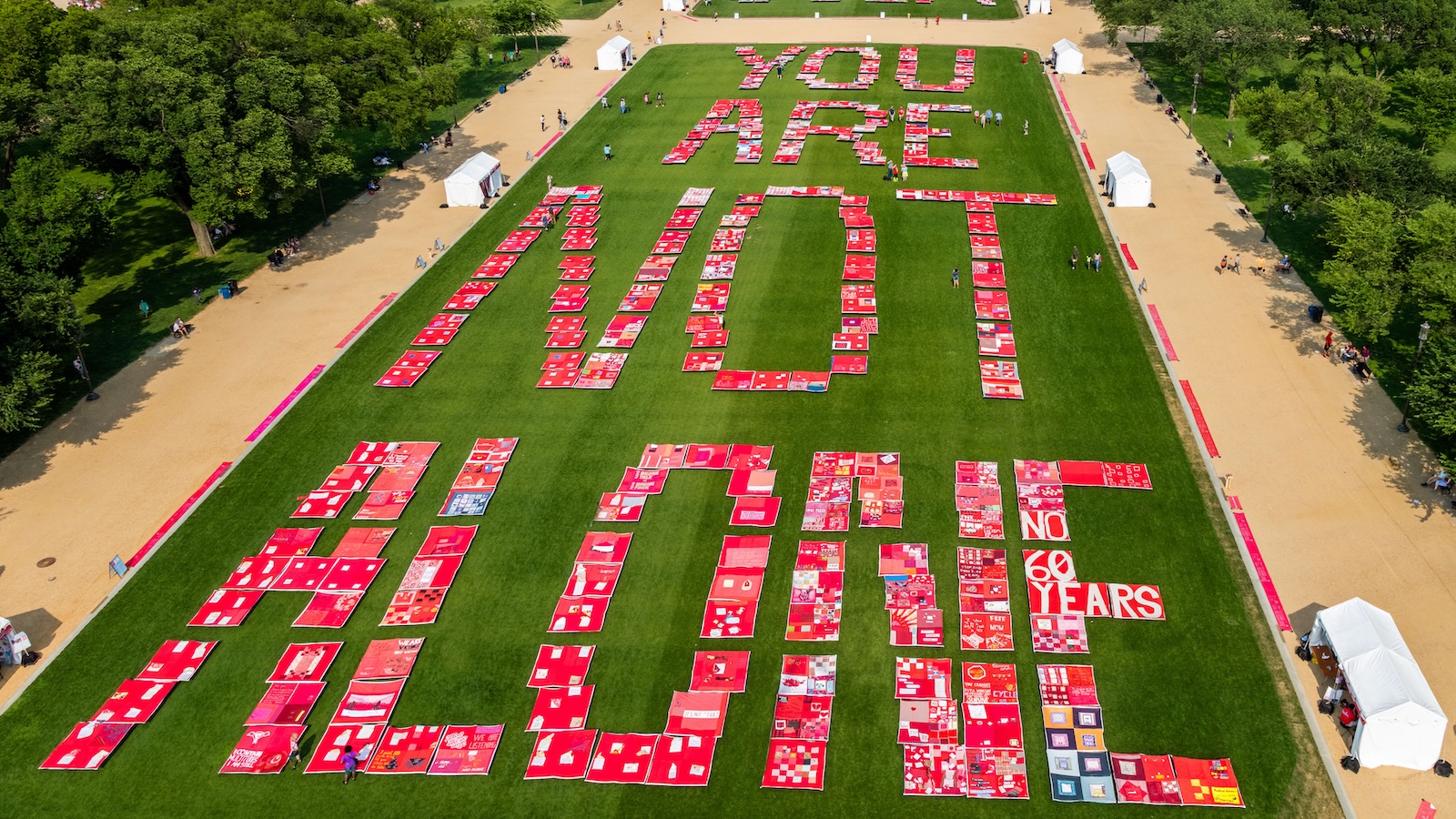
American studies Ph.D. student Hannah Brancato combines scholarship, art and community to understand trauma and possibility.
By Jessica Weiss ’05
On a June day in 2019, the National Mall was blanketed in red. From a distance, it appeared as a single monumental message: “You Are Not Alone,” in English and Spanish. But up close, visitors saw a field of hand-painted and hand-stitched details: 3,000 stories from survivors of sexual and intimate partner violence, sewn into 8’x8’ blocks in public defiance of silence and shame.
For artist, educator and organizer Hannah Brancato, that installation, called the Monument Quilt, was the culmination of years of work with FORCE, the collective she co-founded in 2010 to create public art that pushes back against cultural acceptance of sexual violence. Now a third-year Ph.D. student in American studies at UMD, she continues to be shaped by the experience of guiding the quilt’s creation and public display.
“I came back to school to understand the various contexts that shaped the collective movement work I was part of,” she said. “In many ways I’m still processing it all these years later.”
Brancato, a textile artist, holds a Master of Fine Arts in Community Art from Maryland Institute College of Art and has taught community-based and socially engaged practices in Baltimore and beyond since 2011. At UMD, she’s focusing on the role of art and material culture in anti-sexual violence movements, drawing on material culture studies, women of color feminisms and critical disability studies.

“For me, art is research,” she said. “Material is both a metaphor and a way of working through the deeper contexts and experiences we carry.”
That inquiry is rooted in her own personal story. In a 2021 TEDx talk, Brancato described losing her older sister, Emmy, in a car accident in 2005 when she was a teenager, and how grief “completely unraveled the reality” she thought she knew. In the aftermath, her mom began cutting apart and resewing Emmy’s handmade clothes into memorial quilts for friends and family, which Brancato now recognizes as her first lesson in collective grieving through art.
After moving to Baltimore to study art, Brancato began working at House of Ruth Maryland, a domestic violence shelter, where she set up an arts and crafts program with residents. Sitting together to quilt, crochet and talk was healing. There, she also learned about domestic violence as a “system”—of power and control, red flags and cycles of abuse. Somewhere in those conversations, she realized that her own “rebellious” teenage years had included unrecognized experiences of intimate partner violence and sexual assault, and she began to identify as a survivor.
“Art became a way to name what had happened and to connect with others who shared that experience,” she said.
In 2010, years before the #MeToo movement exploded, FORCE emerged in response to a rape joke made by a comedian in Baltimore that deeply affected survivors and members of the city’s arts community. From the beginning, the Monument Quilt was organized through an intersectional framework, centering the anti-violence work of Black and Indigenous women and highlighting how sexual violence is tied to immigration policy and criminalization—broadening the conversation beyond a traditional focus on policing and punishment. The quilt ultimately grew into a traveling memorial and community space, displayed 50 times across the U.S. and Mexico—in parks, on football fields, outside prisons, on reservations, along the U.S./Mexico border—before its final installation on the Mall.
Today, FORCE is led by Brancato and artist and activist Mora Fernández. Their efforts are focused on archiving the Monument Quilt, with 150 of 700 sections already in permanent collections at the National Museum of the American Indian, Baltimore Museum of Art, Reginald F. Lewis Museum of African American History and Culture, as well as university archives and private collections.
For Brancato, American studies offers the opportunity to bring her creative practice into deeper conversation with theory and history. After years of public-facing organizing work, she wanted time to situate her practice within broader intellectual and political dialogues. In the program, she’s delved into disciplines including medical humanities, critical disability studies, psychoanalysis, queer theory and the Black feminist histories of anti-sexual violence movements.
This fall, many of those threads came together in “We Will Not Be Silent,” the exhibition Brancato curated at UMD’s Stamp Gallery. Each of the four artists featured in the show contributed to the Monument Quilt in different ways, and the exhibition highlights the broader scope of their practices. They include Jadelynn St Dre, a sex and relationship therapist whose performance work centers queer and trans survivors; Nickole Keith, a Potawatomi painter who mourns the impact on missing and murdered Indigenous women; Eva Salazar, a Mexico City-based artist whose mixed-media pieces explore identity and transformation; and Gloria Garrett, a Baltimore folk artist whose colorful paintings celebrate Black history, joy and community.
Textiles, salt sculptures, paintings and quilt blocks in the show act as what Brancato calls “carriers of memory.” By externalizing stories that might otherwise remain locked in “body-minds,” she argues, material culture invites viewers to confront “communal histories we must hold and address together.”
Through her doctoral work, Brancato is exploring how communities can metabolize inherited trauma into something new, how art can illuminate sexual violence as a structural issue and how survivors might one day access forms of repair and accountability outside carceral systems that “actually just create more violence.” One direction she’s considering for her dissertation is a reimagined digital presence for the Monument Quilt, perhaps as an expanded archive that includes new oral histories and connections across the wide network of people who helped build it.
“To dream a new world, we have to face the past,” she said. “Being here at UMD gives me the time and space to follow those questions and to imagine what could come next.”
Visit “We Will Not Be Silent,” at UMD’s Stamp Gallery through Dec. 15.
The top photo, by photographer Nate Gregorio, features the Monument Quilt on the National Mall, organized by FORCE: Upsetting Rape Culture. The second photo is from the Dreamseeds workshop at BMA Lexington Market, featuring Hannah Brancato and collaborator Sanahara Ama Chandra. Photo by FAITH McCorkle.