

How a Philosophy, Politics and Economics Major Helped Shape a Policy Brief for Congress
April 03, 2026
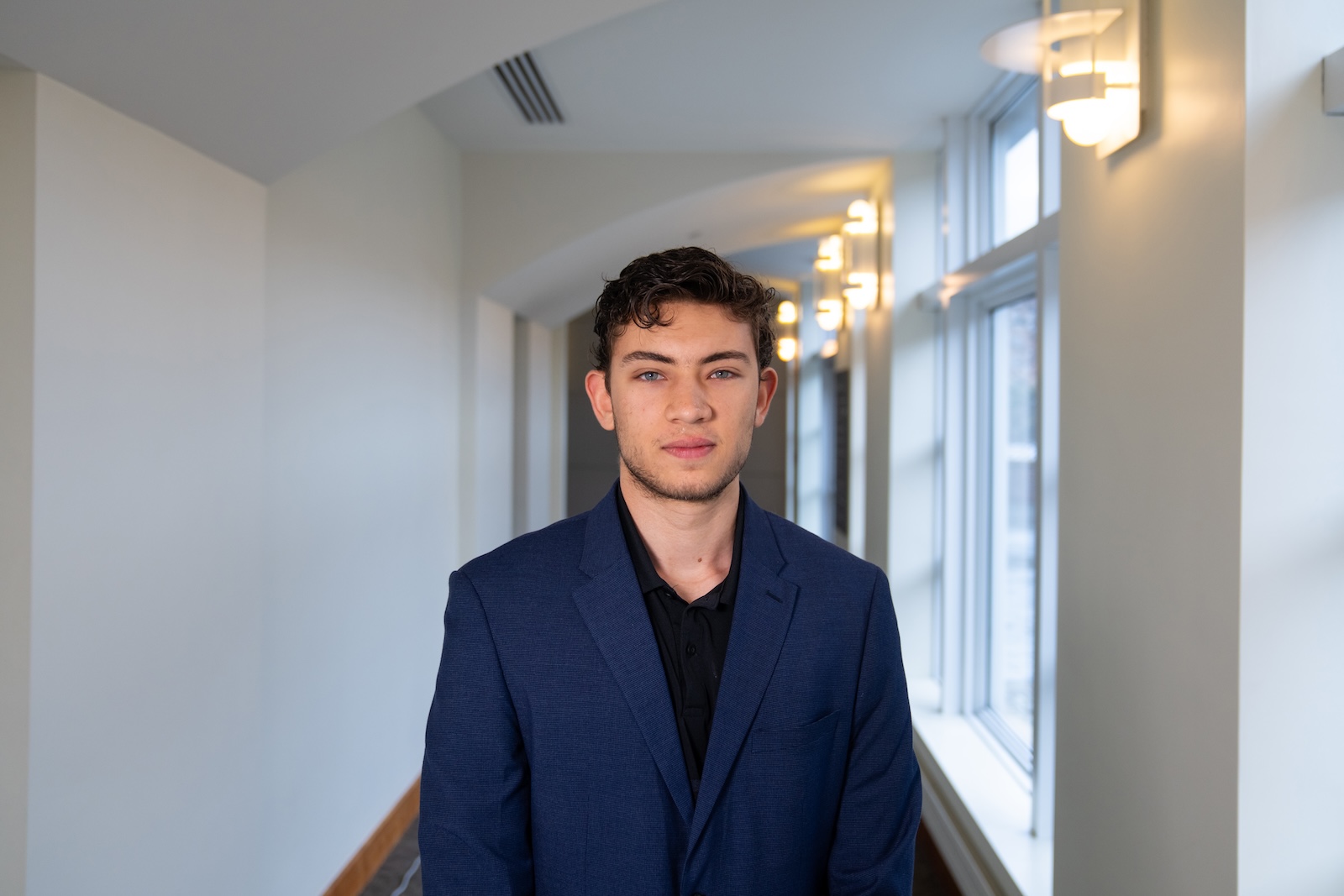
Senior Liam Little ’26 has used the interdisciplinary PPE major to explore global issues, conduct research and gain hands-on experience in diplomacy and policy.
By Jessica Weiss ’05
As part of a professional working group earlier this year, University of Maryland senior Liam Little helped draft a policy brief on Venezuela’s political future, writing a section on what a realistic national transformation could look like and recommendations Congress should consider.
For Little, a philosophy, politics and economics (PPE) major, the project—led by the D.C.-based Alliance for American Leadership—brought together much of what he had been building toward during his time at Maryland: research, writing, policy analysis and a personal connection to global affairs. With a mother from Caracas, Venezuela, and an upbringing shaped by years living abroad in Senegal, Indonesia, Panama and Turkey because of his family’s diplomatic work, international politics has always felt personal.
That global perspective is one reason PPE felt like the right fit. Little arrived at Maryland undecided, interested in economics, politics, public policy and history but unsure how to choose just one path. A recommendation from an advisor led him to PPE, an interdisciplinary major in the Department of Philosophy in the College of Arts and Humanities.
“I didn’t want to box myself into one thing,” he said. “PPE really gives you that opportunity to explore and learn more about yourself through different courses, and figure out what you’re actually interested in.”
Modeled after a longstanding program at the University of Oxford, PPE is designed for students interested in public service and leadership, offering a flexible structure that encourages exploration across disciplines.
Little said that flexibility has allowed him to explore widely while sharpening skills that apply across many fields. He has taken courses in political philosophy, elections, entrepreneurship, creative writing and professional writing, building what he describes as a “stronger voice” while learning how to adapt it for different purposes.
“Each type of writing is completely different,” he said. “A public policy memo isn’t the same as a philosophy paper, and that’s completely different from writing for a business course or creative writing. Being able to move between those has helped me improve and find my own style.”
The program has also given him room to pursue ambitious research projects rooted in his own experiences. For his PPE capstone, Little wrote a 25-page paper on legal and political institutions in Senegal and their impact on economic growth, drawing on the four years he spent there in high school. For a Latin American and Caribbean Studies elective, he completed a 30-page paper on authoritarianism in Venezuela and the evolution of the Chavista regime. Along the way, he interviewed experts, activists and government officials—experiences that helped prepare him for real-world policy work like the brief he contributed to earlier this year.
Professor of Philosophy Dan Moller, who was Little’s PPE capstone advisor, said he “embodies the spirit of the program.”
“Understanding how foreign affairs, politics and economics intersect is more important now than ever, and Little is already contributing to that endeavor,” Moller said.
Outside the classroom, Little has pursued internships that reflect the same range of interests. He is currently interning at the Embassy of the Dominican Republic, where he has rotated through commerce, consular and political sections, writing reports in English and Spanish and getting a firsthand look at diplomatic work. He has also interned with the Hispanic Heritage Foundation and the CoST Infrastructure Transparency Initiative in Panama, where he conducted research on governance and transparency issues in Latin America.
He’s also learning the value of networking. The Venezuela policy brief, for example, grew out of a relationship with the Alliance for American Leadership’s founder and executive director, whom he had previously reached out to about getting involved.
Now, Little is considering careers in diplomacy or international development, but he is also interested in writing, entrepreneurship and graduate study down the line. PPE, he said, has helped him feel prepared to “go in a lot of different directions.”
For students with broad interests, Little sees PPE as a space to ask big questions, try different kinds of work and discover unexpected strengths.
“I think it’s a great major,” he said. “If you have a lot of different interests and you’re not exactly sure what path you want to take, it gives you the space to explore that. You can take courses that challenge you, try things you didn’t expect to enjoy—and in the process, learn more about what you actually want to do.”
Photo by Taneen Momeni.